
[ad#antonio]
Samsung con Universal Display si è impegnato nel realizzare i nuovi AMOLED/PHOLED, pannelli OLED più efficienti e con una resa dei colori più fedele alla realtà.
La stessa Universal Display, azienda che detiene il brevetto della tecnologia PHOLED, ha illustrato quali sono i punti forti di questi nuovi display.
Il PHOLED è essenzialmente un pannello OLED fino a quattro volte più efficiente rispetto ai classici OLED che abbiamo visto finora sul mercato:
“A PHOLED phosphorescent OLED is an OLED that has up to four times higher efficiency than that of a conventional fluorescent OLED. OLEDs are monolithic, solid-state devices that typically consist of a series of organic thin films sandwiched between two thin-film conductive electrodes. When electricity is applied to an OLED, charge carriers (holes and electrons) are injected from the electrodes into the organic thin films. Then, under the influence of an electrical field, these carriers migrate through the device, until they recombine forming excitons. Once formed, these excitons, or excited states, relax to a lower energy level by giving off light and/or heat. With conventional fluorescent emission, only about 25% of the excitonic energy generates light, with the remaining 75% lost as heat. Through the use of certain phosphorescent materials, our university partners at Princeton University and the University of Southern California discovered in the late 1990s that up to 100% of the excitonic energy could be converted into light. This discovery was a major breakthrough. It meant that OLEDs could be up to four times more efficient than previously through possible – enabling OLEDs to compete today with LCDs as well as incandescent and fluorescent lighting in the future.”
La nuova tecnologia brevettata permetterebbe di integrare all’efficienza un maggiore risparmio energetico, con una luminosità fino a quattro volte superiore rispetto agli attuali OLED, cioè permetterebbe a questa tecnologia di competere anche con i pannelli LCD.
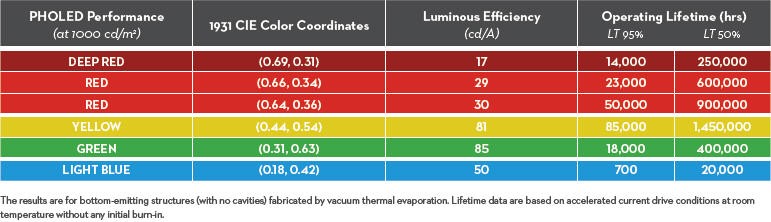
“Our patented UniversalPHOLED® phosphorescent OLED (PHOLED) technology and award-winning materials are integral to enabling low power consumption in OLED displays and lighting. With luminous efficiencies that are up to four times higher than with fluorescent OLED materials, PHOLEDs also reduce heat generation and enhance the number of AMOLED backplane choices. These important PHOLED advantages allow OLEDs to compete with LCDs and conventional light sources. Universal Display continues to demonstrate advances in its UniversalPHOLED technology and materials. As shown below, we unveiled advances in luminous efficiency and operating lifetime for a number of our color systems at SID 2012. Today, our reds and greens offer extremely long lifetimes under a variety of operating conditions, and our blues continue to improve toward commercial entry targets. Our enhanced light-blue phosphorescent OLED emitter system with a 2x improvement in lifetime offers the potential for significantly reduced power consumption and extended operational lifetime in OLED devices for both display and lighting applications. For lighting applications, it may accelerate the introduction of a variety of initial commercial products where high-efficacy, warm-white emission is important. The new system also offers key performance advances for displays when used in Universal Display’s new four sub-pixel format. PHOLED technology and materials are well suited for use in a variety of manufacturing processes. A number of our PHOLED materials have been tested on commercial vacuum thermal evaporation (VTE) manufacturing equipment – demonstrating the extended cycle times needed for high-volume production. PHOLEDs are also compatible with OVPD™ organic vapor phase deposition, laser induced thermal imaging (LITI) and other novel deposition/patterning techniques, including ink jet printing, currently under development. PHOLEDs may be an excellent “green” solution for displays and lighting. With increased energy efficiency, PHOLEDs can reduce the demand for electricity and non-renewable fossil fuels. Also, OLEDs may significantly reduce the waste and disposal issues commonly associated with CRTs and fluorescent tubes.”
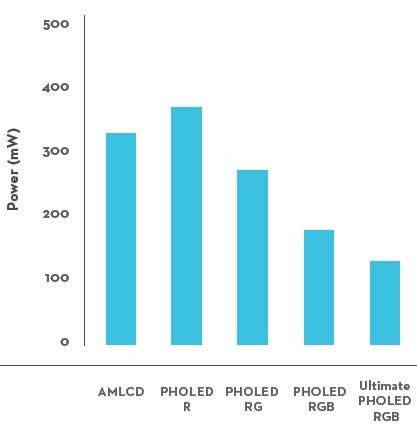
Ovviamente anche ottimi risultati per quanto riguarda il risparmio energetico come ci illustra Universal Display:
“UniversalPHOLED technology and materials have become recognized for their key role in making OLEDs well suited for battery-operated mobile devices, such as smart phones, as well as for large-area TVs and white lighting. To demonstrate this advantage, we have modeled the power consumption of an active-matrix OLED (AMOLED) using our UniversalPHOLED technology and material, as compared to an AMLCD. Based on a 4” diagonal display, operating at 300 cd/m2 with video rate (40% pixels on), the power savings are significant.
Low temperature rise
Because electrical energy that is not converted into light is converted into heat, displays and lights generally experience a temperature rise while operating. This elevated temperature becomes especially palpable in a large-sized OLED TV or lamp. PHOLED technology can dramatically reduce this increase. For example, the temperature rise in the FL-OLED TV would be about 30°C while the temperature rise would be reduced to 10 – 17°C with PHOLED technology (assuming a 40” diagonal AMOLED). A low operating temperature is very important. It prolongs OLED lifetime as degradation increases with increasing temperature. It also reduces the amount of air conditioning required to remove the generated heat – making PHOLED technology an important element in any “green” or environmental building strategy.
Backplane compatibility
Today, amorphous silicon (a-Si) backplane technology is the incumbent for AMLCDs, with a mature, low-cost installed manufacturing base. Low temperature polycrystalline silicon (LTPS), a relative newcomer, uses more complex and therefore higher cost processes. However, LTPS is higher performance – offering higher carrier mobility so that driving circuitry can be integrated directly onto the substrate for lower cost, esp. for small-area displays. In addition, as LTPS transistors can be smaller than their a-Si counterparts, they can ease the fabrication of very high resolution displays. Conventional wisdom has also suggested that the higher mobility of LTPS would be required to meet OLED’s high current drive conditions. This was the case until PHOLED technology was developed. The lower current drive of a PHOLED reduces the current requirements of the TFT backplane, thus reducing its mobility requirements. As a result, PHOLED technology has become a key enabler for the possible use of a-Si backplanes in large-area displays. In the future, PHOLEDs may also help enable the adoption of lower-cost organic TFTs. Also, there is an increasing interest in pursuing metal oxide TFTs for display backplanes. Once again, the lower current requirements of our PHOLEDs lowers the power consumed in the backplane. As a result, our PHOLED technology should also work very well with metal oxide TFT technology as it matures into production.”
Insomma tante piccole novità per i prossimi display AMOLED/PHOLED. Chissà se lo ritroveremo realmente sul prossimo Galaxy S IV.
Non capisco cosa c’entri la “nuova” tecnologia quando con un Kernel come quello di Franco posso gestire e settare i colori come voglio. Mah.
devi leggere l’articolo
dicono di avere questa nuova tecnologia che ha un rendimento molto maggiore al precedente OLED,
dicono 100% ma è un pò utipistico secondo me…
hanno ancora dei problemi con il colore blu…
non so di quanto vecchi siano quei testi in inglese, ma non è detto che sia già pronta la cosa per gli s4 (altrimenti molti faranno da tester in questo senso)
cmq bello il progresso, i LED sono il futuro..
Detto così sembra buono, ma saremo a vedere come saranno questi nuovi display solo una volta visti dal vivo.
Per adesso non cambio il mio s3. . Non credo le differenze saranno molte. . Sicuramente passerò al galaxy s5…
Quotone…
Anche perché trenta mesi son trenta mesi. :-)
AHAHAHAHAHAHAHAHAHAHAHAHA
Nooooo che mi hai ricordato :'(
Ah si? Immagino tu lo faccia diventare un retina display settando i colori…
Retina display è solo un termine di marketing che ha inventato apple per i farlocchi.
Indica un display con un ppi di almeno 326, che ora come ora è superato da tutti i flagship di tutte le aziende.
Es.
htc one 469 ppi
xperia z 441 ppi
Perché voi sapientoni parlate tutti senza sapere niente? (sia di questa nuova tecnologia che del resto) Lavorate alla Samsung o alla Apple per caso? Dai svelateci questo s4 visto che sapete già tutto.
Bomber! Te chiamano volpe a te.
PHOLED = FOTTO LED, ossia ti fotto vendendoti il solito amoled con colori falsi che neanche è paragonabile ad un true ips
È quello che penso anche io. Diversamente da come ciarla qualche bomber che non capisce un cazzo di settaggio di colori, contrasto, luminosità (vedi sotto il bomber Roberto), credo che vogliano fotterci spacciando una chissà quanto rivoluzionaria tecnologia con un semplice amoled con settaggi differenti. Potrò pure leggere milioni di pagine in proposito, ma basta guardare i fatti. Dateve na svegliata porcozzio.
vorrai dire porchiddio
non posso vendere amoled spacciandoli per qualcos’altro… magari la resa colori non cambia molto ma il risparmio energetico c’è
quindi colori un poco più defeli ma soprattutto molta più efficienza energetica… bene…
A me frega poco, basta che i bianchi siano bianchi, preferisco i bianchi al deep nero, visto che quando navighi DI SOLITO, i siti hanno lo sfondo bianco, sai che mi frega del nero!!! E poi la luminosità, che manca e anche di tanto!
Il mio bianco e’ bianco, il nero e’ nerissimo e la luminosita’? a volte acceca lo tengo a meta’. non capisco di cosa parli. Se hai visto schermi gialli o blu sul bianco e’ perche’ son difettosi, ce ne sono in giro un bel po’ :)
Mah, io mi baso su quello che si vede in giro in ogni video, e anche di quello che dice la gente. Siccome ancora non l’ho preso baso le mie supposizioni su tutto questo. È innegabile che però i bianchi dell’Amoled non sono paragonabili a quelli di un IPS. Poi se tu, senza offesa, sei abituato a vedere i TV samsung settati su colore Dinamico, allora non dico nulla. Io faccio il grafico e ci lavoro con monitor ecc…Di punto di bianco ne capisco qualcosina.
Non é che tutti sano l’inglese benissimo,e tradurre a volte cose così specifiche, per alcuni può diventare un problema
Specialmente per chi come te non sa nemmeno l’italiano
Non si può nemmeno più dimenticare una n…
NO NON PUOI!
In realtà è più grave l’aver scritto delle virgole a cazzo…
Ho un note 2 con amoled e matrice rgb che settato su colori naturali è perfetto………….
Ma sono più luminosi degli amoled soprattutto all aperto?
I principali difetti dell’amoled sono: i colori poco naturali (se confrontati con un qualsiasi lcd), la risoluzione finta (rgbg vs rgb, con una densità inferiore di 1/3 rispetto a quanto dichiarato) e la luminosità (350 nit degli amoled più luminosi contro una media di 450 nit di un lcd).
Del resto hanno anche tanti pregi come i neri neri, i consumi ridotti e lo spessore quasi nullo.
Rgb e rgbg si riferiscono ai sub pixel non ai pixel.
Lo so, e se abbiamo 2 subpixel al posto di 3 la risoluzione viene calata di 1/3 quindi su una risoluzione a 300 ppi rgbg abbiamo circa 200 ppi di un rgb
Salve, io ho avuto un gs3 e sinceramente i colori non mi sono mai sembrati male anche perché è un telefono e nn ci faccio grafica ad alti livelli o prove di colore.
Quello che a mio avviso fa la differenza è la visibilità all’esterno.
Con l’s3 nn si vedeva niente neanche al massimo quasi, figuriamoci se mettevi in automatico.
Iphone si vede al sole e secondo me questa è un ottima caratteristica da preferire ai colori più reali del mondo.
Che ne pensate????
Si ma qui sion tutti pippaioli, se l’icona rossa di google plus non e’ fedele alla realta’ questi si incazzano! aspettta!!! ma in realta’ non esiste l’icona di g+!!! e ora?
sinceramente non vedere il display al sole mi da fastidio quanto quardare un video o una foto dove la gente ha la pelle arancione e tutti i colori sono falsati…
[…] (…)Continua a leggere Samsung Galaxy S IV con display PHOLED: ma cos’è il PHOLED? su Andro… […]
[…] (…)Continua a leggere Samsung Galaxy S IV con display PHOLED: ma cos’è il PHOLED? su Andro… […]
Avete provato a leggere sotto il sole?
Questo è il vero problema!
“Ma che cos’è il pholed?”
Semplicemente un finto nuovo prodotto tipo l’iPhone 5…
C’è un altra cosa che dicono.. ossia che saranno RGB. Se davvero monteranno questo display sarà un ottima notizia.
Che i colori siano ipersaturi e, soprattutto se paragonati ad altri dispositivi, piuttosto innaturali, si vede a occhio nudo (per i colori delle icone o certi tipi di immagini può anche andar bene, ma se si guardano foto e filmati la differenza si nota eccome). Idem la profondità dei neri, d’altra parte. Tuttavia, grazie a dio vista la diffusione esiste un parco sviluppatori niente male e, ad esempio, kernel che permettono di bypassare completamente i settaggi e la gestione Samsung. Vedi kernel Perseus.
[…] (…)Continua a leggere Samsung Galaxy S IV con display PHOLED: ma cos’è il PHOLED? su Andro… […]