[ad#ad-alex]
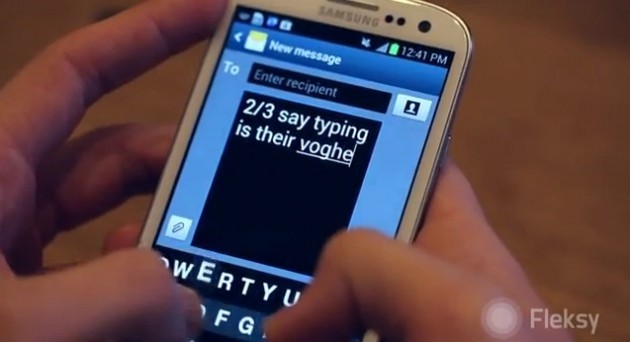
Grazie ad una tecnologia messa a punto dalla società statunitense, Fleksy riesce infatti a predire le parole giuste anche se si sbaglia a digitare ogni singola lettera. Al momento non ci sono molti dettagli sul suo funzionamento, ma è possibile già registrarsi a questo indirizzo (è necessario inserire un link ad un proprio profilo presente su un qualsiasi social network, con LinkedIn come preferenza) per richiedere la versione beta. In attesa di vederla dal vivo al CES 2013, che aprirà ufficialmente i battenti nella giornata di domani, vi lasciamo ad un primo video di presentazione:
Revolutionary Fleksy Keyboard Solves the Problem of Typing on Touch Screens, Debuts New Engine and Android Version at CES 2013
Fleksy Technology to be on Display at Eureka Park within The Venetian, as well as at the Innovations Showcase for CES Design and Engineering Awards Honorees
2013 International CES
SAN FRANCISCO–(BUSINESS WIRE)–Syntellia, creators of Fleksy, the technology that solves the problem of typing on touchscreens once and for all, will debut the next generation of the prediction engine and introduce Fleksy for Android at CES 2013. Fleksy makes it possible to type accurately without even looking at the screen, and will be on display within the Eureka Park exhibit area. Eureka Park is at The Venetian, Level 3, Lido 3101, Murano 3201-3301, San Polo 3404. Fleksy is booth 74308.
“Typing is still the biggest frustration for customers using smartphones and tablets. The result is that some people won’t buy a touchscreen device, and others won’t use their devices nearly as much as they could. It’s actually the biggest barrier to smartphone and tablet adoption right now”
Syntellia’s Fleksy uses a predictive text technology that makes accurate typing easy on touchscreens, even when you miss every single letter. Fleksy outperforms all current market offerings both in terms of input speed and accuracy – so much so that users can type as fast on touchscreens as they do on laptops.
Syntellia’s patented technology features such a powerful autocorrect engine that visually impaired users have been using it to type as easily as sighted people do on touchscreen devices. At CES, Syntellia will debut of the next generation of Fleksy’s prediction engine, which brings the technology out of the disability market and into the mass market – with user interface innovations and support for multiple languages. CES 2013 will also be the debut of Fleksy on multiple platforms, including Android.
“Typing is still the biggest frustration for customers using smartphones and tablets. The result is that some people won’t buy a touchscreen device, and others won’t use their devices nearly as much as they could. It’s actually the biggest barrier to smartphone and tablet adoption right now,” Kostas Eleftheriou, Syntellia co-founder and CEO, said. “Fleksy solves the problem once and for all. Once you have used a touchscreen device with Fleksy, you won’t remember how you ever got along without it. Just like magic, you have to see it to believe it, so we welcome everyone to visit our booth at CES and see Fleksy in action.”
Fleksy is a CES Innovations 2013 Design and Engineering Awards Honoree, and will also be on display at the Innovations Showcase at the Venetian. This prestigious award is only given to a handful of the most innovative technologies to be launched every year.
Fleksy is launching its beta for Android and Spanish during CES and interested users can register at http://beta.fleksy.com to download a preview of the technology.
Non pensavo che i ciechi comprassero uno smartphone touch. però, come iniziativa non è male.
sì, però prendono tutti l’iphone di solito, che ha un motore di sintesi vocale davvero notevole
Si stava parlando dei ciechi, non degli i-dioti
Però è vero. Conosco 2 persone non vedenti che si sono presi un iPhone perchè evidentemente è molto più adatto per loro
quindi non di te?
ma te lo ha ordinato il dottore di dare aria ai denti?
Io ci sto lavorando nel campo dell’accessibilità android per i non e gli ipo vedenti e ti posso garantire che apple è parecchio più avanti su questo aspetto (anche se android piano piano sta colmando il gap che li divide, ma fino alla 4.2 il suddetto gap è ENORME).
Che io sappia non si scrive coi denti, anche se, vista la tua capacità di comprendere le battute, immagino che tu lo faccia.
MMMMMMMMM GLI HANNO DETTO CHE CE ANCHE LA DETTATURA VOCALE?
la dettatura non va assolutamente bene in tutte le situazioni, metti solo che ci sia rumore ambientale.
Metti solo il rumore ambientale può essere ridotto su alcuni dispositivi
sei sull’autobus con gente attorno che parla, devi scrivere un sms, come fai?
la sintesi vocale è molto comoda, ma non è utilizzabile in tutte le situazioni, per questo sono importanti tastiere del genere.
per inciso non capisco perchè mai dobbiate parlare completamente a sproposito e senza cognizione di causa.
Daje il rumore di fondo può essere ridotto! Non per altro i telefoni top di gamma escono con 3 microfoni! Non hai un top di gamma? Ci sarà sicuramente o inventeranno un modo per ridurre il rumore di fondo! Personalmente nessun problema in autobus con gnexus e cuffiette originali! Anche se quelli vicini mi guardano storto xD
Poi io parlo quando cazzo ho voglia e dico tutte le minchiate che voglio!
CMQ IL CEO DI STA DITTA SON SICURO CHE E SPAGNOLO,PARLA COME ALONSO
ma dovrebbe esserci già per ios, o sbaglio? Suo loro sito dicono di sì…
Sì, ma quella per Android ha un sistema di predizione rinnovato
in che senso? Hanno versioni diverse per android e ios? O.o
Probabilmente poi verrà aggiornata anche quella per iOS
C’è dentro Giuacobbo che indovina il futuro con gli Egitto negli spaziali
Estiqaatsi!
sparati
Fatti ‘na sega, ma fatta bene che non si sa mai.
che Bello, posso scrivere!
cit. Cieco
Ti diverte tutto ciò vero? ……
A ME SI,GUARDA COME RIDE ,SEMBRA CHE CI PRENDA PER IL CULO
Mi chiedo perché leggo androidiani, quando potrei leggere la notizia direttamente in inglese…
[…] ti è interessato questo articolo continua a leggere il post originale Qui, oppure scrivi cosa ne pensi con un commento qui sotto. Per noi è molto importante sapere cosa ne […]
[…] (…)Continua a leggere Fleksy: una tastiera alternativa che può essere usata anche da un cieco su… […]
Scusate ma non esiste già SwiftKey 3 in grado di fare questo tipo di cose??
Mi sfugge la differenza con Swiftkey che fa queste cose da mesi…
[…] (…)Continua a leggere Fleksy: una tastiera alternativa che può essere usata anche da un cieco su Andro… […]
[…] (…)Continua a leggere Fleksy: una tastiera alternativa che può essere usata anche da un cieco su… […]